36 Japanese Architectural and Landmark Icons for Creative Workflow Integration
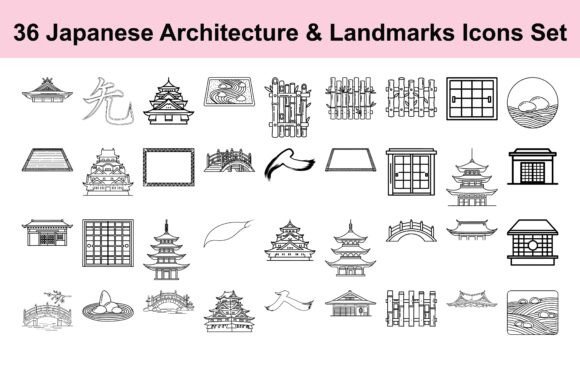
The 36 Japanese Architectural and Landmark Icon Set offers a curated collection of traditional Japanese structures, designed to enhance visual storytelling and cultural representation in creative projects. These icons serve as essential tools for professionals across various industries, from tourism and education to design and marketing. By incorporating these elements into workflows, creators can add authenticity and depth to their work while maintaining a cohesive aesthetic.
Understanding the Role of 36 Japanese Architectural and Landmark in Projects
Before diving into specific use cases, it's important to recognize how this icon set fits into broader project planning. Whether you're developing a travel guide, designing an educational infographic, or creating branding materials, these icons provide a consistent visual language that aligns with Japanese cultural themes. Their simplicity and elegance make them adaptable to different mediums, ensuring they remain relevant across digital and print formats.
For instance, in the early stages of a project, these icons can be used to brainstorm visual concepts or define thematic elements. During execution, they can be integrated into layouts, presentations, or promotional content. After completion, they may support long-term brand consistency or future updates to existing materials.
Practical Applications Across Industries
The versatility of the 36 Japanese Architectural and Landmark Icons allows them to be utilized in multiple ways depending on the field. For educators, these icons can illustrate historical or architectural lessons, making complex topics more accessible. In the tourism sector, they can be embedded into maps, brochures, or digital experiences to highlight key locations and cultural landmarks.
Designers and developers can leverage these icons in website templates, mobile app interfaces, or social media graphics. The availability of multiple file formats—such as AI, EPS, and JPG—ensures compatibility with various design software and platforms. This flexibility supports seamless integration into existing workflows without requiring significant adjustments.
Integration with Other Tools and Resources
When working on a project, the 36 Japanese Architectural and Landmark Icons often interact with other assets, such as photographs, illustrations, or data visualizations. For example, a travel blog might pair these icons with high-quality images of temples or shrines to create a visually engaging narrative. Similarly, a marketing campaign could combine these icons with branded typography and color schemes to reinforce a cohesive message.
Collaboration with team members also benefits from using standardized visual elements. When all stakeholders have access to the same icon set, it reduces confusion and ensures consistency in output. This is particularly useful in large-scale projects where multiple designers or developers are involved.
Workflow Examples and Implementation Tips
Consider a scenario where a small business owner is launching a cultural tourism initiative. They might begin by selecting relevant icons from the 36 Japanese Architectural and Landmark Set to represent key attractions. These icons can then be used in promotional materials, such as posters, email newsletters, or website banners. By maintaining a uniform style, the business can establish a professional and culturally informed brand identity.
Another example involves a freelance graphic designer tasked with creating infographics for a client. The designer can incorporate these icons to illustrate historical timelines, architectural evolution, or cultural significance. The black outline style ensures clarity and readability, even when scaled down for mobile devices or printed materials.
Factors to Consider for Effective Use
To maximize the value of the 36 Japanese Architectural and Landmark Icons, several factors should be considered. Preparation is key—reviewing the available icons and understanding their cultural context helps avoid misinterpretation. Compatibility with design software and file formats should also be verified to ensure smooth implementation.
Usability is another critical aspect. The icons’ simplicity makes them easy to manipulate, but their effectiveness depends on proper placement and sizing. Organization is equally important; keeping a structured library of icons allows for quick access during the design process. Quality control measures, such as checking resolution and vector integrity, help maintain professional standards.
Long-term use should also be planned. For businesses or individuals who frequently update their content, having a reliable source of icons ensures continuity. Regularly reviewing and updating the icon set can also help maintain relevance as trends and design preferences evolve.
Enhancing Creativity and Cultural Authenticity
While the 36 Japanese Architectural and Landmark Icons are practical tools, they also inspire creativity by offering a foundation for cultural storytelling. By drawing from Japan’s rich architectural heritage, these icons encourage designers to explore new ways of representing tradition through modern visuals.
For those working on Asian-themed designs, these icons provide a way to celebrate cultural diversity without relying on stereotypes. Their clean, minimalist style aligns with contemporary design trends while respecting historical accuracy. This balance makes them ideal for both educational and commercial applications.
Conclusion: A Valuable Asset for Visual Communication
The 36 Japanese Architectural and Landmark Icon Set is more than just a collection of images—it’s a resource that supports effective communication, cultural appreciation, and creative expression. By integrating these icons into workflows, professionals can enhance the quality and authenticity of their projects while streamlining the design process.
Whether used in tourism, education, marketing, or personal creative endeavors, these icons offer a versatile solution for visual storytelling. Their adaptability, combined with high-quality design, makes them a valuable addition to any toolkit focused on Japanese culture or architectural representation.